GR(1) contracts
GR1IoContract extends Pacti's assume-guarantee operations to temporal
component requirements in a typed, bounded-next fragment of GR(1). It is
intended for compositional analysis of component specifications. It is not a
controller synthesizer or a general LTL engine.
A GR(1) contract separates environment assumptions from component guarantees. Each side is divided into three buckets:
| Bucket | Meaning |
|---|---|
init |
formulas that hold in the initial state |
inv |
formulas that hold at every state |
liv |
formulas that hold infinitely often |
The entries in each bucket are conjoined. Liveness entries remain separate
liveness obligations: liv: ["p", "q"] denotes GF p & GF q, rather than
GF(p & q).
Typed interfaces and formulas
Every interface variable has sort bool, int, or real. Assumptions may
refer only to input variables, while guarantees may relate inputs and outputs.
The following contract initializes an integer counter, increments it after an
enabled step, and requires the threshold to recur:
from pacti.iocontract import GR1IoContract

counter = GR1IoContract.from_dict({
    "input_vars": ["enable"],
    "output_vars": ["count"],
    "variable_sorts": {"enable": "bool", "count": "int"},
    "assumptions": {},
    "guarantees": {
        "init": ["count = 0"],
        "inv": ["enable -> X(count) = count + 1"],
        "liv": ["count >= 10"],
    },
})
X(value) and next(value) refer to the next value of a variable. A bounded
number of nested next operators is supported. Core formulas may use Boolean
operators, comparisons, parentheses, exact decimals, and rational linear
integer or real arithmetic. The outer temporal operator is supplied by the
bucket. Arbitrary G, F, and U operators are not accepted inside a core
formula.
Contract operations
GR(1) contracts support Pacti's composition, quotient, merge, refinement, and
serialization operations. Composition connects components and hides shared
internal variables. Quotient computes a contract for a missing component from
a system contract and a known component. Merge conjoins compatible viewpoints
without hiding connected variables. The dictionary returned by to_dict()
records the interface, sorts, and formulas and can be passed to from_dict().
For refinement, candidate.refines(specification) attempts to prove that the
candidate has no stronger environment assumptions and no weaker guarantees.
A True result is a sound finite-certificate result. A False result is
inconclusive in general: the refinement may be false, or the implemented
finite support search may not find a certificate.
Composition and quotient use Context-Aided Variable Elimination (CAVE) when an internal variable must be hidden. CAVE combines the projected formula with relevant initial, invariant, and liveness context. The resulting bounds are sound for the implemented fragment, but temporal variable elimination is not exact for every GR(1) formula. In particular, Pacti does not claim completeness for arbitrary infinite traces or solve the GR(1) realizability game.
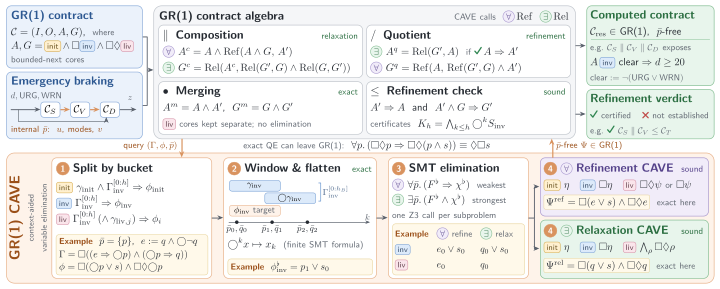
Figure 1: Contract operations use refinement or relaxation CAVE to return a GR(1) contract over the desired interface.
Boolean and linear integer or real arithmetic are the validated solver scope.
Solver unknown, unsupported quantifier elimination, and unexpected tactic
results raise GR1SolverError when a conclusive result is required. They are
not accepted as proofs.
Examples
The GR(1) Getting Started notebook composes a cooling controller with a fan actuator and eliminates their internal command. The automatic emergency-braking case study uses real and Boolean variables to compute a system contract and a quotient. The complete API reference documents the public class and solver exception.
Pacti 0.4.0 and later include
GR1IoContract and require Python 3.11 or newer. The implementation is
maintained in the Pacti source repository.
python -m pip install pacti
python -c "from pacti.iocontract import GR1IoContract; print(GR1IoContract.__name__)"